Season of Grace
Straight ManSeason of Grace is Tony Coniglia’s name for the stage of life that follows youthful striving: the point at which a person must acknowledge diminished powers and reckon with what those powers have made of them. Introduced during a late-night conversation with William Henry Devereaux, Jr., it becomes both a teasing philosophy of aging and a serious measure of the choices, disappointments, and compromises that have accumulated around them.
Tony’s Account of the Season
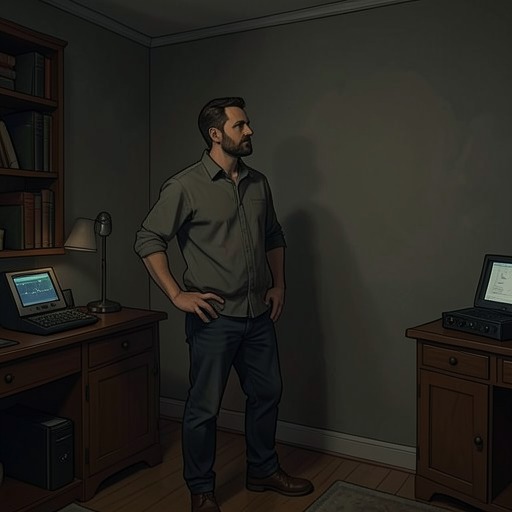
Tony offers his theory on William Henry Devereaux, Jr.’s deck, after Lily has gone to bed. A bottle of Irish whiskey sits between the two friends; Tony has come to say farewell before leaving for Pittsburgh for a year as a sabbatical replacement. He announces that they have entered the Season of Grace, then reaches for Beowulf as his example of a warrior confronted with age.
In Tony’s version, a warrior eventually realizes that he no longer has his best stuff. He may imagine himself still capable of the deeds that defined him, but honesty would require him to admit that he could not take on Grendel’s mother in a fair fight. The point, Tony insists, is the dragon: Beowulf was an old warrior by then, and should not have fought it. His skills had diminished; the time for deeds had passed. The grace he failed to show, in Tony’s account, was the grace to recognize that change and stop.
The conversation is deliberately less polished than the theory. William Henry Devereaux, Jr. corrects Tony’s memory of the poem: Beowulf defeated Grendel’s mother and, as he recalls, killed the dragon too, though the fight mortally wounded him. Tony concedes the detail only to restate his point. William Henry Devereaux, Jr. counters that fighting the dragon is what makes Beowulf a hero; Tony sees the same fight as a refusal to acknowledge that his powers have waned. Their disagreement leaves the term unsettled: does grace mean laying down the warrior’s role, or continuing to act even when victory may cost everything?
From Deeds to Self-Assessment
Tony contrasts the two seasons by the questions they ask. Youth, the Season of Deeds, asks, “Who am I?” In the Season of Grace, the question becomes, “What have I become?” The change is not simply from action to inactivity. It is a change in the standard by which a life is understood: aspiration and future possibility give way to an inventory of character and consequence.
Tony’s language draws its force from the particular lives surrounding the conversation. The people William Henry Devereaux, Jr. thinks of have spent their academic careers at West Central Pennsylvania University in Railton, although many once believed they were made for better things. Finny never finished his dissertation. June Barnes received an offer from a decent university on the strength of a well-placed article, but the prospective employer would not hire Teddy Barnes as part of a package deal, and Teddy had just earned tenure. Later, when Teddy had a chance to move into administration, June talked him out of it, perhaps in revenge. Even Gracie DuBois’s poetry once showed promise. These are distinct paths not taken, not a single shared failure: opportunities arose at different times and were constrained by work, marriage, loyalty, or decisions the people involved made themselves.
The career that resulted is also shaped by the institution’s daily demands. Committee work, departmental politics, lesson plans, and students’ increasingly militant ignorance have helped years pass without the academics intending to let them go. By middle age, William Henry Devereaux, Jr. sees that the group has chosen anger at one another over anger at itself. Their daily proximity makes each colleague a reminder of abandoned possibilities. The harder possibility is that being made for better things does not guarantee that anyone will do them.
The Cost and Comedy of Looking Back
An earlier reflection gives the phrase a sharper, more melancholy setting. After leaving Tony’s house, William Henry Devereaux, Jr. remembers that his car is downtown and walks about ten blocks down the hill. Halfway there, he ducks into the woods to urinate. The pause turns into an accounting of what Missy Blaylock’s joking complaint about being wasted in Railton has come to represent: a community of colleagues who expected more from their lives and now have to look at one another, and at what they did not pursue.
That meditation does not treat regret as proof that a better life was waiting, fully formed, somewhere else. Rather, the speaker recognizes how easily people can redescribe missed chances as evidence that they were meant for greater things, while refusing to face their own part in the outcome. Tony stands out as comparatively contented, and his contentment lends his philosophy an edge: he may be more able to live in the present because he is not spending the same effort measuring his life against an imagined alternative.
The Beowulf exchange keeps that seriousness from settling into solemn instruction. Tony misremembers the poem, is corrected, briefly mistakes which monster mattered to his argument, and finally gives up with, “Okay, fuck Beowulf. There are no more warriors anyhow.” William Henry Devereaux, Jr. answers that there are no more Grendels and jokes that men their age cannot even find a good Grendel’s mother, much less know what they will do when they are old enough to look for dragons. Tony then offers the plainest personal version of his theory: “No dragons for me,” he says; he has entered the Season of Grace. When William Henry Devereaux, Jr. says that he and Jacob Rose have done so too, Tony jokes that Jacob has merely entered Gracie. The joke lets the abstract label bump against ordinary life, romance, and aging without dissolving the concern beneath it.
William Henry Devereaux, Jr.’s Reluctant Acceptance
For William Henry Devereaux, Jr., the Season of Grace remains an invitation rather than a fully accepted condition. He later concludes that his relative lack of happiness and gratitude may come from not having completely accepted his friend’s invitation to join those who have lost their best stuff. The phrasing turns Tony’s idea into a continuing test of self-understanding, not a verdict that age automatically brings wisdom or peace.
Two athletic changes give that test concrete form. Before Julie leaves for Atlanta, she beats her father at tennis in a two-set match lasting just under an hour. On a warm Sunday afternoon she moves him from sideline to sideline and net to baseline; he recognizes that she has stopped responding to the warnings and psychological tactics that had helped him make her double-fault for years. Her radiant smile after the match makes the victory more than a score: she has done what she had not quite believed possible. She explains that it is for what he did to Russell, leaving him briefly to wonder whether she means his role in Russell’s departure before he remembers the basketball game that sent Russell’s hook shot onto the roof.
The second change is William Henry Devereaux, Jr.’s own decision to leave left field and play first base. After jogging throughout the spring in hopes of keeping his outfield place, he concedes the position rather than waiting to be displaced. First base suits competence, reliability, patience, and faith; it can bring satisfaction when a difficult throw is dug out of the dirt, but not the same jolt of awe as tracking a long, high hit. Phil Watson’s nephew takes over in left field. He begins the season with twice William Henry Devereaux, Jr.’s speed and half his judgment, but judgment can improve with experience, while speed cannot be recovered in the same way. The move is therefore neither pure defeat nor uncomplicated acceptance: it is a practical adjustment to a real difference in capacity, accompanied by the knowledge of what the adjustment costs.
Meaning and Limits of the Expression
The Season of Grace gathers these episodes into a vocabulary for aging without pretending that a vocabulary resolves it. Tony’s formulation challenges the fantasy that a person can keep performing the defining deeds of youth indefinitely. Yet William Henry Devereaux, Jr.’s defense of Beowulf preserves the other side of the dilemma: retreat can look like wisdom, but an old warrior’s final act may also be heroic. Their argument refuses to make diminished ability synonymous with diminished worth.
The expression also unsettles the idea that acceptance must mean happiness. William Henry Devereaux, Jr. can be relatively at peace with who he has become and still wonder why he is not more grateful. He can move to first base voluntarily and still feel the loss of left field; he can recognize Julie’s victory and feel its sting as a father. Tony’s final judgment of himself is comic—“I have become very drunk”—and his praise of William Henry Devereaux, Jr. as his best student ends the exchange on affectionate irony. The theory offers no neat cure for regret. Its grace lies in seeing the change clearly, while the question of what to do with that knowledge remains open.